


Your Own Private Sailboat Costs Less Than You Think
The mental block is the word "charter." It lands with a particular weight, suggesting something that belongs to a different tax bracket entirely. But if you've ever spent close to $5,000 on a week of accommodations and still ended up paying separately for every meal, every activity, every taxi to the beach, it's worth doing the math differently.
A crewed sailing charter on a private yacht bundles most of that into one number. Your accommodation moves with you. A professional captain handles the boat. A private chef goes to the local market each morning and cooks for your group that evening. You wake up in a new anchorage every day. And when you split that across three or four couples, what looked like an extravagance starts looking like a reasonable alternative to the vacation you were already considering.
What You're Actually Getting
A crewed charter on a sailing catamaran means you show up with your bags and the boat does the rest. The captain handles navigation, routing, anchoring, and all the seamanship. You're a passenger with a spectacular vantage point, not someone who needs to know how to read a chart.
The private chef is where the experience becomes genuinely hard to replicate anywhere else. A good charter chef doesn't work from a fixed menu. They go to the local market each morning and buy what's fresh: whatever the fishermen brought in, whatever's in season, whatever the island is known for. In Croatia that might mean grilled sea bream and local wine on the aft deck as the sun drops behind a medieval coastal town. In the British Virgin Islands it's fresh lobster, bought from a fishing boat that pulled alongside that afternoon. Meals happen when and where you want them: breakfast in a quiet cove, lunch anchored off a beach, dinner in a harbor. There is no reservations app. There is no waiting.
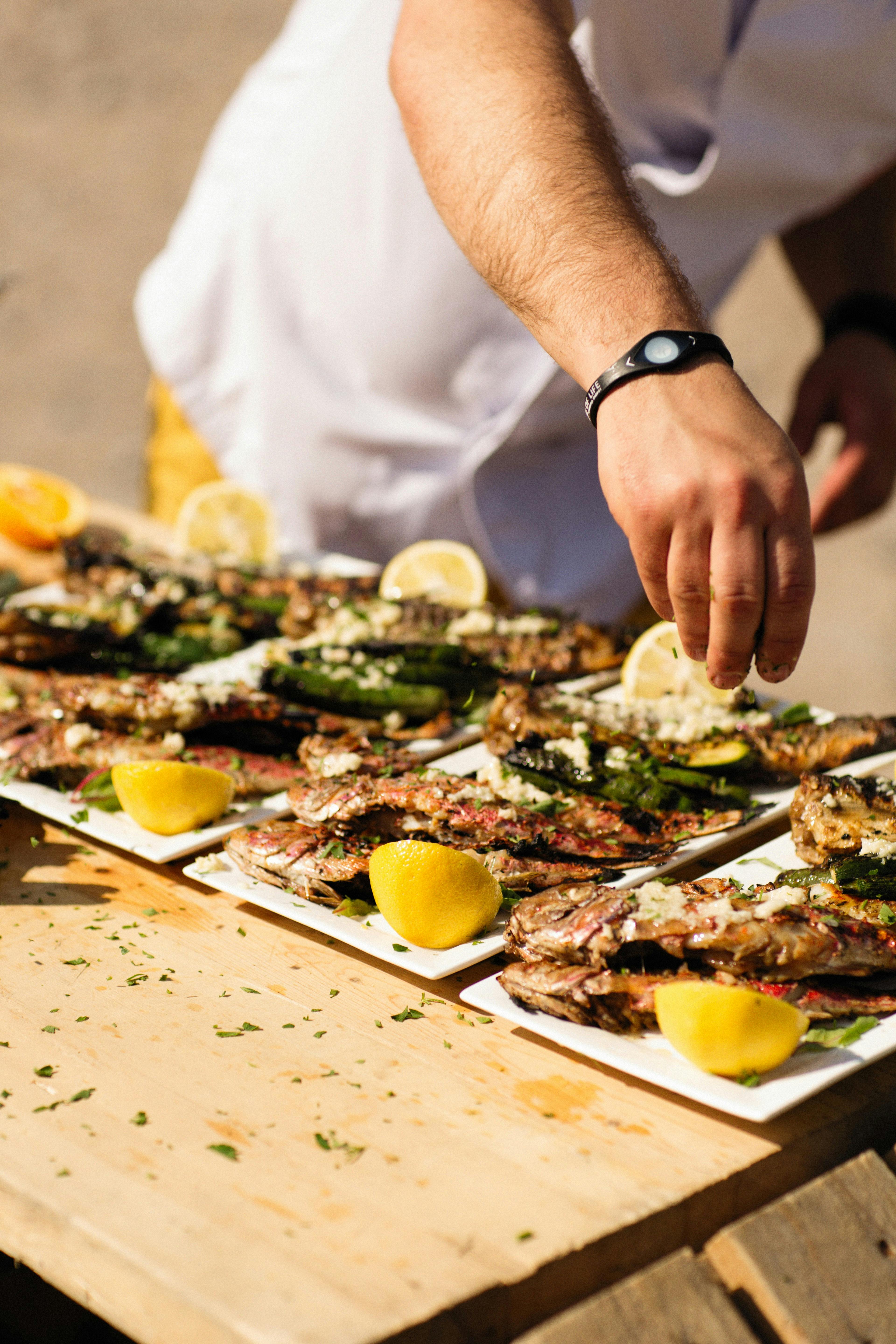
Fresh catch from the Mediterranean, prepped dockside before making it to the table that evening.
The catamaran itself typically provides four to six private cabins, each with its own bathroom, spread across a hull that has more square footage than most hotel suites. The cockpit and deck function as an outdoor living room that changes scenery daily. This is not roughing it.
The Numbers, Split Among Couples
Here's where the conversation changes. The charter price covers the whole boat, not per person, which means the more couples you bring, the more favorable the math becomes.
A 45- to 50-foot sailing catamaran with a full-time captain runs roughly $9,000 to $15,000 per week depending on the boat, destination, and season. Add a private chef at $150 to $300 per day and provisioning at $50 to $75 per person per day, and for a group of eight people the all-in weekly cost lands somewhere between $16,000 and $25,000, depending on how generously you want to provision and what part of the world you're sailing.
Divided four ways, that's $4,000 to $6,250 per couple for the week. That covers your accommodation, all your meals prepared from local ingredients, a professional captain, fuel, and the ability to move through one of the world's great sailing destinations on your own schedule.
Compare that to a $5,000 week of accommodation where restaurant dinners for two run $150 to $200 a night, where you're paying for taxis and boat trips and entrance fees, where the view from your room doesn't change. The gap narrows considerably when you account for what you're actually spending on the land-based version.
Mooring fees ($30 to $40 per night) and a damage deposit waiver ($600 to $900 for the week) are the main additions to budget for. Drinks aboard are typically handled separately by the group. Aside from that, most expenses are folded in.
Where to Go, and How the Pricing Shifts
British Virgin Islands: Best First Charter
For a first charter, the British Virgin Islands is hard to beat as a starting point. The inter-island distances are short enough that you're never far from the next anchorage, the trade winds blow reliably from December through April, and the infrastructure around charter sailing is as developed as anywhere in the world. It's also one of the few Caribbean destinations that charges no charter tax, which makes a real difference when you're tallying the full cost. Shoulder season in May or November delivers nearly identical conditions at 20 percent less.
Croatia: Best All-Around Value

Arriving by boat is the best way to see Cavtat. Most visitors to the Dalmatian coast never make it this far south.
Croatia tends to surprise people. It runs 20 to 30 percent cheaper than the Caribbean for a comparable setup, and what you get in return is a coastline of medieval port towns, clear Adriatic water, excellent local wine, and island markets that give the private chef genuinely good material to work with. Sailing between Hvar, Korčula, and Vis feels more like moving through history than ticking off beaches. May, June, and September are the months to aim for; July and August are peak season and the crowds show it.
Greece: Best for Variety
Greece shares similar pricing to Croatia and rewards groups who want more variety. The Ionian islands on the western coast are calm, green, and well-suited to first-time charterers. The Aegean is windier and more dramatic, better for confident sailors who want a bit more going on. Either way, the combination of island character, food, and setting is hard to overstate, and early June in the Ionian sits in a sweet spot where the weather is reliably good and the marinas are still quiet.
The Grenadines and Thailand: The Road Less Chartered
For groups who want something farther off the beaten track, the Grenadines offer a Caribbean experience that feels genuinely remote. The chain runs from St. Vincent down to Grenada, and anchoring inside Tobago Cays, a ring of uninhabited islands enclosed by coral reef, is the kind of thing that's difficult to describe accurately to someone who hasn't been there. Thailand, sailing out of Phuket, is at the more affordable end of the global spectrum and offers a completely different landscape: limestone karsts rising straight out of flat water, fishing villages reachable only by sea, and local markets that are some of the best in the world for a chef who knows what to do with them.
How to Book
For a crewed charter with captain and chef, working with a broker is often the most practical approach, particularly for a first booking. Independent brokers compare boats across multiple companies at no additional cost to you; they earn their commission from the boat owner. They can match your group size, dates, and destination to the right vessel, negotiate pricing, and handle the logistics of adding chef services if the boat doesn't already include them. Boatbookings, Ed Hamilton & Co., and NauticEd Vacations are all well-regarded options for this.
If you'd prefer to book directly with an established company, The Moorings is the most widely recognized crewed charter operator globally, with a large fleet across the Caribbean, Mediterranean, and beyond. Dream Yacht Charter operates one of the world's largest fleets with skippered and crewed options in over 50 destinations. Sunsail, part of the same parent company as The Moorings, runs a strong fleet particularly in the Mediterranean. For BVI and Grenadines specialists, Horizon Yacht Charters is consistently well-reviewed.
Most charter companies that offer captained trips can also arrange chef services on request. If it's important to you, confirm the chef arrangement at booking and ask about how provisioning is handled. Some chefs prefer to manage the provisioning budget themselves, which tends to be the better arrangement.
When to Book
Peak Christmas and New Year's weeks carry a 15 to 25 percent premium above standard high-season rates and tend to book out a year or more in advance. The most favorable combination of price and conditions is almost always shoulder season: May to early June or November in the Caribbean, May or September in the Mediterranean. Booking six to nine months out is standard for a first charter; later than that in peak season and the best boats are typically gone.
Early booking discounts are available through most operators and brokers. Occasionally last-minute deals emerge when a boat goes unbooked, though you're unlikely to get your first-choice vessel or destination.

Fresh sushi, champagne, and nowhere to be until morning. The per-couple math starts making a lot more sense out here.
The Honest Pitch
A crewed sailing charter is not the cheapest vacation you'll ever take. But it's not the most expensive either, and it's one of the few travel formats where the cost actively goes down the more people you bring. Four couples sharing a week on a sailing catamaran in Croatia are paying roughly the same per couple as two people in a well-reviewed hotel in the same country. One of those options comes with a captain, a chef, private cabins, and a different view every morning.
If the $5,000 accommodation week is already on the table, it's worth running the numbers on the water version before you book.


